
Can a Tight Pelvic Floor Cause Constipation?

(What I Look At When Fiber Isn't Enough)
Yes, a tight pelvic floor can be part of why you're still constipated. And in my experience it's the piece that gets missed most, because almost every piece of advice you've been given is about the poop itself: make it softer, make it bulkier, make it move. That's useful, up to a point. But softer stool still can't get through a door that won't open, and for a lot of the women I work with, the door is a pelvic floor that has forgotten how to let go.
If you're here, I'm guessing you've already done the sensible things. More fiber. More water. Prunes, kiwis, magnesium, coffee. MiraLax most mornings. Maybe you cut out dairy or gluten for a few weeks to see if it changed anything. Maybe you bought the toilet stool. And you're still sitting there, pushing, scrolling your phone, waiting for something to happen, then walking away feeling like you're not done.
You've done what you were told. When that hasn't been enough, I want to look somewhere else, and that's what this post is about.
What actually has to happen for you to poop
Most of us never think about this, so stay with me for a minute, because it changes how everything else makes sense.
Your pelvic floor is a group of muscles at the base of your pelvis. One part of it, a sling of muscle called the puborectalis, loops around the back of your rectum like a hand holding a bent hose. When it's holding, it keeps a kink in that hose, which is a big part of how you stay continent all day without thinking about it. Good job, pelvic floor.
When it's time to go, that sling needs to relax and lengthen. The kink straightens, the muscles around the opening soften, and stool can pass with gentle effort and a relaxed breath. That letting go is as much a skill as holding is.
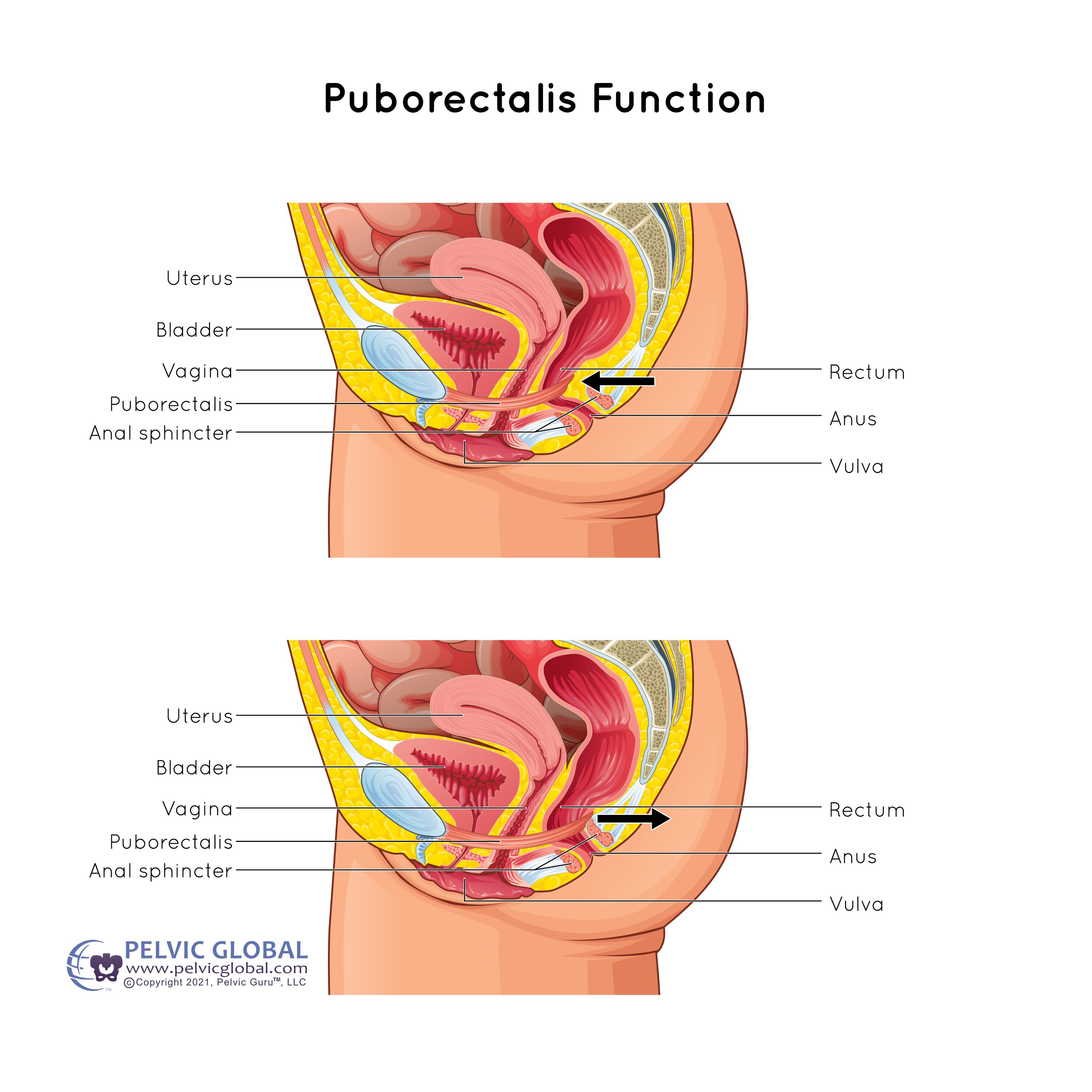
(Top: the puborectalis holding, keeping a bend in the rectum. Bottom: the puborectalis relaxing so the bend straightens and stool can pass).
Now imagine that sling doesn't let go. Maybe it's been holding for years, maybe it tightens up the moment you sit down and try. You push harder, it holds harder, and you're working against yourself. In the clinical world this pattern is called dyssynergic defecation, which simply means the muscles that should be relaxing are tightening, or not relaxing enough, at the moment you're trying to go.
That's the door. Everything you do to the stool happens on one side of it.
Signs the door might be part of your constipation
None of these diagnose anything on their own. But when I hear a few of them together, the pelvic floor goes to the top of my list.
- You never feel finished. You go, you get up, and ten minutes later you're back. Some mornings it's three trips.
- Your poop is thinner than it used to be. Narrow, ribbony, "skinny poops," or as one woman put it to me, like something is blocking it.
- The urge comes, and then nothing. You feel it, you sit down, and it just won't come.
- You strain, even when it's soft. If MiraLax has made everything soft and you're still pushing, that tells me a lot.
- You shift around to get it out. Leaning, rocking, lifting a foot, or pressing somewhere to help it along.
- Your bladder isn't happy either. Urgency, going a lot, or that not-quite-empty feeling after you pee. Bowel and bladder share the same pelvic floor, so they often show up together.
If you're nodding along to more than one of these, keep reading.
Why fiber, water and MiraLax only go so far
I want to give all of these their due, because none of them are bad advice. Fiber adds bulk and helps stool hold water. Water keeps it soft. MiraLax and similar laxatives draw more water into the bowel so things move more easily. If your stool is hard and slow, they can make a real difference.
The thing they all have in common is that they work on what's trying to get through. Not one of them asks the muscle at the exit to relax.
So if the exit is the problem, you can end up in a frustrating loop. You add more fiber and feel bloated and full, because now there's more bulk queuing up behind a door that's still closed. You take more MiraLax and it's soft, and you're still straining, still not finished. Then someone suggests you try a different brand, or double the dose, and the loop starts again.
And to be really clear, keep doing whatever you've been prescribed or recommended. I'm adding a missing piece of the puzzle to it, the piece that's about your muscles rather than your diet.
Your pelvic floor doesn't exist in isolation
This is the part I care about most, and the part I find gets skipped. Even when someone does look at the pelvic floor, it's often just the pelvic floor. But it's connected to everything around it, and when it's holding on, I want to know what else is holding on too.
Your breath
Your diaphragm and your pelvic floor move together. When you breathe in, the diaphragm drops and the pelvic floor gently lengthens down with it. When you breathe out, they both lift. If you hold your breath and bear down on the toilet, which almost everyone does when it isn't coming easily, you lose that natural lengthening and the whole trunk braces instead. I'd much rather see you breathe it out than push it out.
Your jaw
A clenched jaw and a clenched pelvic floor often go hand in hand. If you grind your teeth at night or catch yourself pressing your teeth together during the day, these are both holding patterns that likely stem from the same root cause. Try it now: clench your jaw hard and notice what your pelvic floor does. Then let your jaw hang loose and notice again.
Your hips
Your hips and your pelvic floor are close neighbors. One of the deep hip muscles, the obturator internus, actually shares an attachment with part of the pelvic floor, and tight hip flexors like the psoas often come with a pelvis that's braced. When the hips are guarded, the pelvic floor rarely gets to relax on its own.
The way you sit on the toilet
Knees lower than hips, back rounded or perched upright, scrolling for ten minutes. Lifting your knees with a stool can help straighten that kink in the hose, which is why so many people swear by them. It helps the angle. It doesn't teach the muscle to let go, so for some women it's a nice improvement and for others it barely touches the problem.
Years of holding it
Teachers who can't leave the classroom. Nurses on long shifts. Anyone who grew up hating school bathrooms, or who "just doesn't go" at work or when traveling. If you've spent years overriding the urge, your pelvic floor has had years of practice holding, and much less practice letting go.
An old tailbone injury
A fall on your tailbone, even decades ago, can be part of the picture. The pelvic floor attaches to the tailbone, and after an injury it can stay on guard long after the bruise has gone.
Your bladder
If you're constipated and you're also running to the bathroom to pee, getting up at night, or feeling burning with negative tests, I'd want to look at both together. They're managed by the same muscles, and they often improve together too.
Why I wouldn't start with Kegels
Sometimes stronger isn't what your body needs.
A Kegel is a contraction. You squeeze and lift the pelvic floor, and you repeat it to build strength. That's genuinely useful for a pelvic floor that can't hold. But if the problem is a pelvic floor that can't let go, adding more squeezing first is like trying to strengthen a muscle that's already in a cramp. You're training the one thing it's already doing too much of.
A tight pelvic floor isn't the same as a strong one. Real strength needs a full contraction and a full relaxation, and if you can't get the second half, you don't have the full range to work with. That's why I teach release before strengthen. You get the muscle letting go first, then coordinate it with your breath and the rest of your body, and then strength comes back in. And strength does need to come back in. A pelvic floor that grips all the time is often doing extra work to keep you steady, picking up the slack for your glutes and hips. It's a bit like a friend who's been carrying your bags all day. When she finally puts them down, you realize how heavy they are. Once your pelvic floor lets go and stops doing their job for them, you might notice your glutes and hips are weaker than you thought, and we need to start building them up.
Something for you to try
Next time you're on the toilet:
- Put your feet up on a stool or a stack of books so your knees are higher than your hips, and lean forward with your forearms on your thighs.
- Let your jaw go loose, teeth apart.
- Let your belly soften completely. No holding it in.
- Breathe in slowly, low and wide into your ribs and belly, and imagine your pelvic floor gently dropping down as you do.
- Breathe out slowly through your mouth, like fogging up a mirror, and let any effort ride on that breath rather than holding it.
This won't undo years of holding by itself, but it'll show you something useful. A lot of women try this and realize for the first time just how much they've been clenching and bearing down at the same time.
Student win
One woman who did my program told me that within a few days, her constipation was better and that she was now going every day. She also told me she was peeing better. That bladder detail is the bit I love, because it's exactly what you'd expect if the pelvic floor was a big part of what was going on for her.
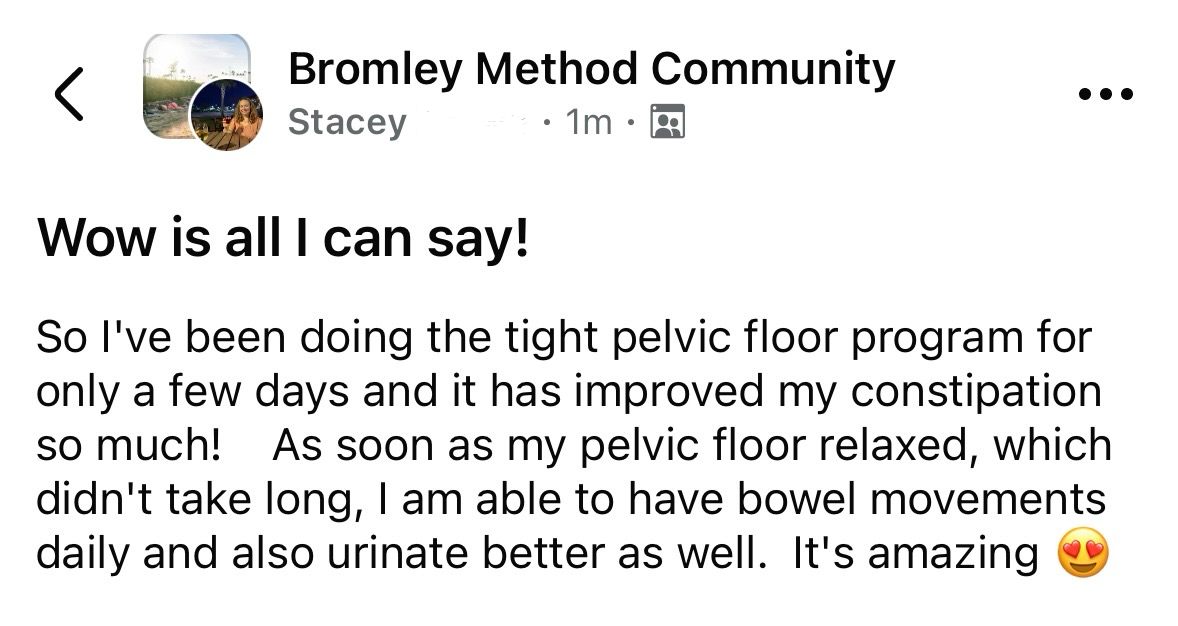
That's her experience, and everyone's body is different. But I hear versions of it often enough that I'd always want to rule the pelvic floor in or out before anyone resigns themselves to MiraLax forever.
Where I'd start
The breathing on the toilet is one piece. On its own, it usually isn't enough to change a pattern your body has been practicing for years, because the release has to happen in your hips, your ribs, your jaw and your breath as well as the pelvic floor itself, and then everything has to learn to work together again.
That's what I built the Tight Pelvic Floor Fix to do. It's a 14-day program you do at home. Each day has a different session with a must-watch of up to 15 minutes, plus optional extras. We start with release, then bring in breath, ribcage and hip mobility and coordination, and only then add strength back in.
See how the Tight Pelvic Floor Fix works
Questions I get asked about this
Should I stop taking MiraLax?
That's a conversation for you and whoever suggested it. This post is for educational purposes only and does not replace medical advice. Release work sits alongside whatever you're already doing.
Can a pelvic floor be tight and weak at the same time?
Yes. A muscle that's holding all the time gets tired and can't produce a strong, full contraction when you need one. That's why the order matters: release first, then rebuild.
Which came first, the constipation or the tight pelvic floor?
Honestly, it can go either way, and it often becomes a loop. Straining against a closed door can make the muscles guard more, and a guarded pelvic floor can make it harder to go. You don't need to know which came first to start working on it.
I've done pelvic floor PT. Is this still for me?
It can be. PT and a home program aren't either/or, and a lot of my students do both. One told me the program helped her further advance the gains she'd made with her PT. Daily practice between appointments is often what makes the difference.
About Emma. I'm Emma Bromley, a Pilates instructor and Corrective Exercise Specialist with more than 15 years' experience (BASI certified, CES PCES certified, IMH certified). After an emergency C-section with my daughter, I learned that a pelvic floor can be too tight rather than too weak, and it changed how I teach. I created the Tight Pelvic Floor Fix to help women who've tried everything see the bigger picture. You'll find me teaching most days on Instagram at @bromleymethod
This post is for education and isn't medical advice. If a symptom is new, sudden or getting worse, get it checked.